
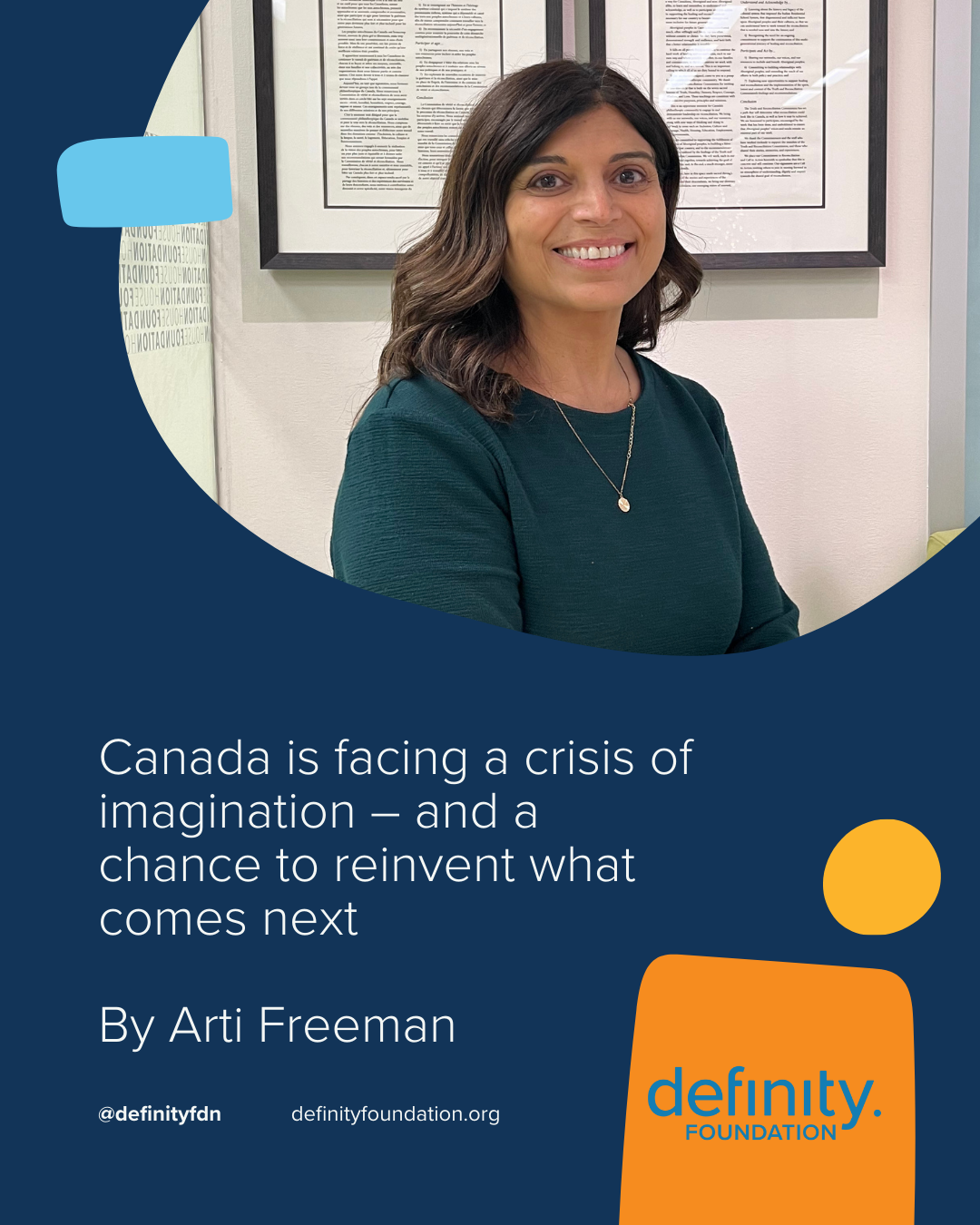
We face a crisis of imagination. ‘Building Canada Strong’ gives us a shot at reinventing what comes next
Read the op-ed published in the Toronto Star
Budget 2025’s “Building Canada Strong” agenda sets out more than $280 billion in investments over five years. With that, we have an opportunity to do things differently.
But the federal government seems to be slipping into old habits, pushing through large infrastructure projects without imagining new futures for the country or how we build toward them.
Capital alone won’t carry Canada into the future — we need imagination. We can’t just leverage existing tools to fix what’s breaking — we need new systems and new kinds of partnerships to build them.
The federal government has acknowledged that what once ensured Canada’s stability and growth is now being disrupted. Yet we continue to invest in the very systems — the way we plan, fund and deliver solutions across infrastructure, economic and social systems — that created these vulnerabilities in the first place.
We are trying to navigate a new world with old maps.
If we want to build resilience, not just repair what’s breaking, we need to harness creativity and innovation from all of Canada’s great minds. We need spaces where non-profits, communities, philanthropy, business and governments can imagine — and build — the systems we need rather than reinforce the old.
The stakes are high.
Generational-scale investments are underway — $51 billion for community infrastructure alone. If we treat this as a moment to reimagine, we can build something fundamentally better: a stronger, more equitable and resilient Canada.
Here are three shifts to get us there:
First, create safe opportunities for testing new ideas where risk is shared.
Creating spaces where non-profits, philanthropy, government and private sector leaders can reimagine systems and create conditions for innovation — such as in housing, clean energy and employee ownership — can lead to solutions tailored for Canada’s future.
It’s not just about pilots, it’s about learning, collaborating, thinking differently and building fundamentally new approaches.
In Denmark, the Bikuben Foundation created spaces where civil society and municipalities could explore long-term challenges, imagine new solutions and test them. The foundation funded the experimentation and shouldered the risk.
Second, involve non-profit leaders earlier as system designers, not just service providers.
Non-profit organizations work on the front lines with communities and understand how current systems fall short.
Bringing them into policy design upfront, not after the blueprint is written, strengthens solutions and prevents costly course corrections later. Philanthropy can step in to support and convene.
Third, make it easier for philanthropic capital and public investment to work together.
What if Canada built simple, repeatable pathways for governments and philanthropy to co-invest in solving big public challenges, creating shared risk-taking, faster testing and a pipeline of solutions ready to scale?
We have seen what’s possible with models like Social Impact Bonds in the U.K., where private and philanthropic investors fund new approaches to address a social issue and government pays for outcomes only when the model works.
In Denmark, the philanthropic Social Investment Fund was integrated as a central part of the Danish ministry of social affairs and housing’s work; this involved collaborating with various stakeholders, including public actors, civil society, foundations and private investors to invest in social welfare solutions using outcomes-based contracts.
We also have our own examples in Canada.
Indigenous-led funds like Raven Outcomes Fund have combined private and philanthropic capital with public programs to scale clean-energy retrofits and create jobs in First Nations communities.
These examples hint at what’s possible, but they remain the exception.
Canada could use such models to address challenges facing the country, including housing, clean energy, workforce development and community infrastructure.
Philanthropy can take early risk through first-loss positions, loan guarantees or proof-of-concept funding. Our governments could co-invest, mitigate risk and attract private capital.
Together, these coalitions could create a system that channels resources into solutions that are scalable, sustainable and community-driven.
Canada needs multi-sector coalitions where non-profit organizations, policymakers, funders, academics and the private sector can co-create entirely new systems rather than perpetuate the old.
If we take these three simple steps, Budget 2025 becomes more than a spending plan; it becomes the spark for reimagining the systems Canada needs to build a resilient, thriving future.