
By Wayne Miranda
If you have recently felt a buzz around « systemic investment », you have sensed right. Initiatives like TransCap Initiative, Financial Ecosystems for Systemic Transformation (FEST), Together We Invest for Systems Transformation (TWIST) are gaining traction globally, while events such as the Systemic Investment Discovery Day and Impact United Academy’s webinar series build momentum here at home in Canada.
Interest and curiosity is growing. But you are in good company if you are asking questions like: « What is systemic investment all about? » and « How is it any different?«
We have made progress with impact investment and blended finance as approaches to direct money towards positive social, environmental, and cultural change. Now, another term enters the conversation. This post will aim to clearly explain « systemic investment », trace its evolution and place in a spectrum of approaches, and discuss why it matters and why it represents the next logical step for how we advance towards our collective wellbeing.
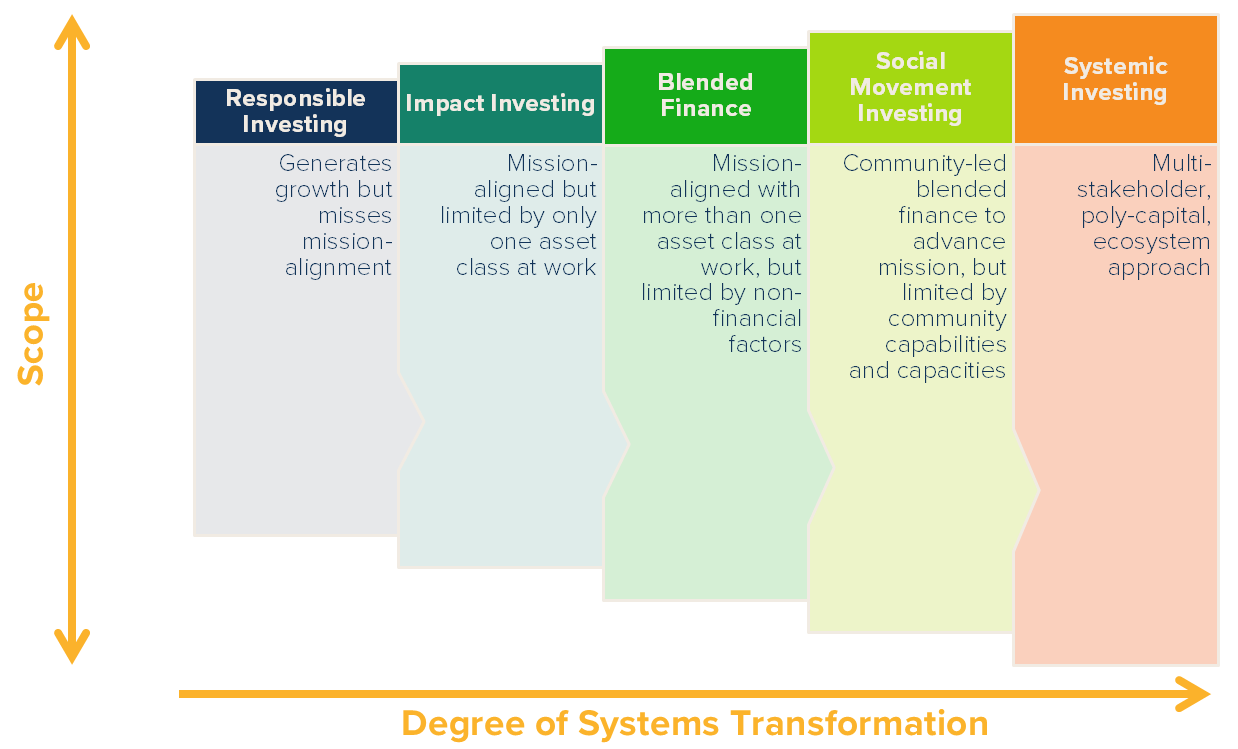
The word “investment” offers a starting point, but it may be counterintuitive. Systemic investment is not just another way of using finance for good—it moves beyond finance alone. Consider that there is a spectrum of approaches, each expanding the scope from the last.
Responsible and sustainable investing focuses on avoiding investments that harm people and the planet. Impact investing goes further to intentionally invest for positive social and environmental change.
Example of an impact investment:
Active Impact invests in early-stage technology companies that meaningfully support the sustainability of our planet. Some example companies include prefabricated net-zero carbon home manufacturing, smart irrigation technology that optimizes agricultural water usage, and lightning prevention technology for wildfire management.
The limits of impact investing are becoming increasingly clear: it often relies on just one type of financing. This leads to blended finance, which combines multiple types of finance such as non-repayable grants alongside repayable loans and equity financing.
Example of blended finance:
Afro-Caribbean Business Network (ACBN) Microloan Fund provides support services helping Black entrepreneurs build their community enterprises. The enterprises that complete the ACBN program and demonstrate an interest and ability to use investment then access microloans to grow their businesses. The entrepreneurs have a greater chance of success when they access grant-funded business development services blended with repayable loans.
Blended finance in turn reveals another limit: typically only financial actors are involved. The response is « social movement investing », where communities lead and shape the financing solutions.
Example: Community-Driven Outcomes Contracts by Raven Indigenous Outcomes Fund (RIOF). RIOF partners with Indigenous communities and investors to respond to community priorities like housing, clean energy, health, and jobs. The RIOF financing tools enable public and private investors to meaningfully support proven solutions in partnership with Indigenous communities.
The approach of social movement investing also has its limit, often constrained by the capabilities and capacities of the community.
Where to next?
Each approach, each step in this spectrum, has widened the scope: from doing less harm, to seeking positive outcomes for society, to employing a range of financing, to including more voices. The natural evolution is to continue increasing the scope of what is considered towards systems transformation.
And that leads to systemic investing.
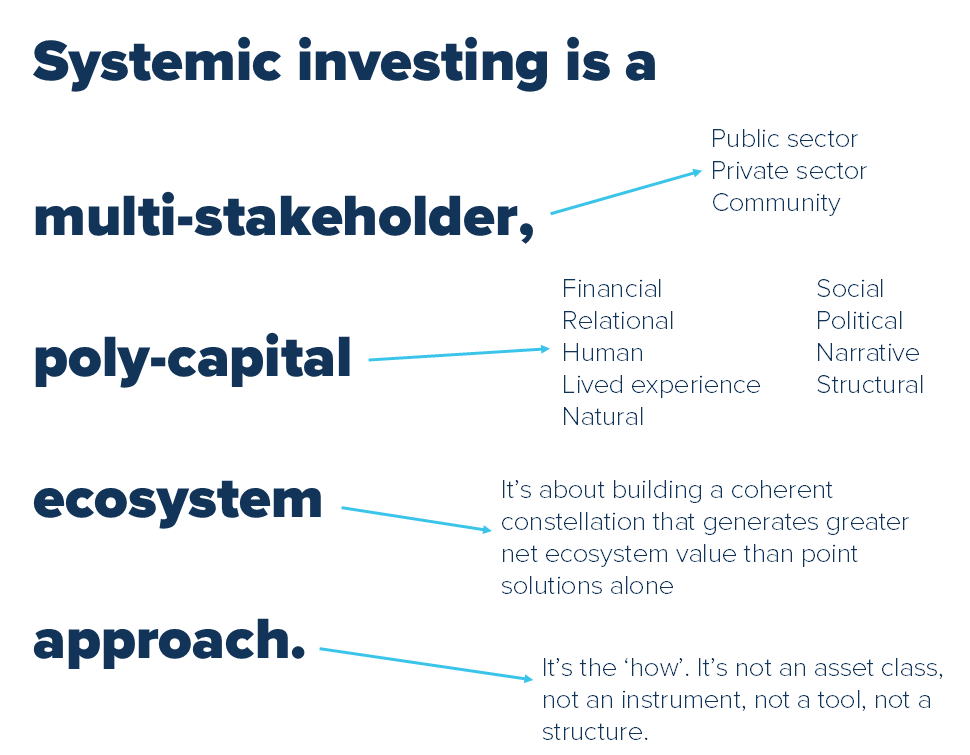
Systemic investing is a multi-stakeholder, poly-capital ecosystem approach.
That definition is compact, yet it captures the core concept and offers common language to practice this approach together. Here is what is means:
- Multi-stakeholder: systemic investing involves the community sector alongside the public and private sectors—including community residents and leaders, community organizations, political leaders and bureaucrats, policymakers and legislators, regulators, investors and funding agencies, businesses, philanthropy, networks and associations—this list could go on. These stakeholders connect, build relationships, share knowledge and experience, and collaborate.
- Poly-capital: systemic investing involves more than money. It can involve the deployment of financial, social, political, natural, structural, relational, human and lived experience, and narrative capital towards systemic transformation. All of these forms of capital aim to work in tandem to build trust and understanding, connection to each other and nature, to energize collaboration, and to develop shared stories of a better future.
- Ecosystem: systemic investing seeks to build a coherent constellation of initiatives that sum to more than its parts. Systemic investing moves beyond point solutions to focus on ecosystem health. Points solutions are connected, feeding back and feeding forward learning, knowledge, experience, and collective action. And the work of each point solution is advanced by shared infrastructure and services to the ecosystem.
- Approach: systemic investing is an approach—it is the ‘how’ to go about deploying multiple types of capital for systemic transformation. Systemic investing is not an asset class alongside fixed income and public equities. It is not an instrument or tool like a loan or a grant. It is not a structure like an impact fund or a funding model. Systemic investing is to be practiced like emergent strategy: non-linear, adaptive, relational.
If this still feels abstract, picture systemic investing as teaming up with everyone to pool strengths like money, skills, trust and ideas into a connected web of projects that enable communities to thrive. We recognize the urgency and complexity of the polycrisis: from inequality, to rising costs of living, housing shortages, mental health challenges, polarization, food insecurity, and climate change. These issues cannot be solved by any one group or initiative alone. Systemic investing matters because it aligns our strengths into coherent collective action addressing the root causes of systemic issues.
We’d love to hear from you!
What resonates about this approach?
What are you already doing or thinking that aligns?
What lingering questions does this spur for you?
What is unclear? What would you want to dig deeper into?